|
Marlene Dietrich never threw away anything. She kept her good-luck black rag doll (it appeared with her in The Blue Angel and followed her to dressing tables on every movie set). She kept the letters (every last one) she received from her lovers and her husband of fifty-three years. She kept every article of clothing made for her by the great French couturiers and the legendary Hollywood costume designers. She kept everything.
 And she believed in storage. Six storage companies, from New York to California, London and Paris, held pieces of Dietrich’s life, locked away for decades like the pieces of the life of Charles Foster Kane. Over the years, hundreds of thousands of dollars were paid in rental fees. After her death, the articles were gathered together—25,000 objects and 18,000 images. Some were auctioned at Sotheby’s in Los Angeles. The major pieces of Dietrich’s vast collection were assembled in an archive and given to the film Museum Berlin. And she believed in storage. Six storage companies, from New York to California, London and Paris, held pieces of Dietrich’s life, locked away for decades like the pieces of the life of Charles Foster Kane. Over the years, hundreds of thousands of dollars were paid in rental fees. After her death, the articles were gathered together—25,000 objects and 18,000 images. Some were auctioned at Sotheby’s in Los Angeles. The major pieces of Dietrich’s vast collection were assembled in an archive and given to the film Museum Berlin.
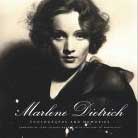
Now in Marlene Dietrich: Photographs and Memories (Knopf, 2001) her treasures are brought together in 289 photographs from her own collection, with extended captions by her daughter, Maria Riva.
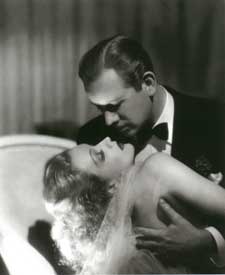
We see Dietrich as a child, in velvet dress and golden ringlets; Dietrich as a young actress in Berlin; as the newly married Mrs. Rudolf Sieber, standing proudly with her husband. We see love letters and letters marking the ends of affairs. We see Dietrich in Hollywood; with Chaplin; with Fritz Lang; at the Paramount commissary; Dietrich captured in snapshots by her movie-creator, Josef von Sternberg; Dietrich as a mother.
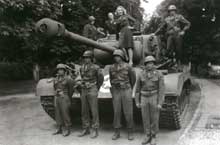
We see her at war; in never-before-published photographs of a USO tour; in uniform (tailor-made for her, of course) disembarking from a transport plane; Dietrich with the 82nd Airborne; Dietrich rolling into Germany in a U.S. tank.
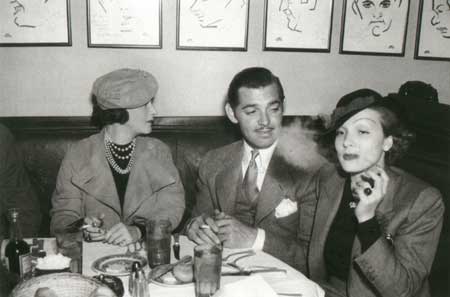
Here she is with her directors and fellow actors: Katharine Hepburn, Claudette Colbert, Judy Garland, John Wayne, Ernst Lubitsch, Clark Gable, Cary Grant, Tyrone Power. Here are portraits of her by Cecil Beaton, Horst P. Horst, Milton Greene, John Engstead. And here is Marlene, shimmering, in Las Vegas, the consummate performer, and at the Palladium in London, triumphant!
Marlene Dietrich was indeed revered, as the following tribute from Ernest Hemingway shows:
If she had nothing more than her voice she could break your heart with it. But she has that beautiful body and the timeless loveliness of her face. It makes no difference how she breaks your heart if she is there to mend it.
She cannot be cruel nor unjust but she can be angry and fools bore her and she shows it unless the fool is in bad trouble. Anyone who is in serious enough trouble has her sympathy.
If this makes her sound too perfect, you should know that she can destroy any competing woman without even noticing her. She does it sometimes for fun and then tosses the man back where he belongs. She has a strange, for these times, code that will not let her take a man away from another woman if the woman wants him.
We know each other very well and are very fond of each other. When we meet we tell each other everything that has happened in between times and I don’t think we ever lie to each other unless it is very necessary on a temporary basis.
All the wonderful stories I could tell you about Marlene. She would not mind and I would not mind. But many people would. Marlene makes her own rules in this life but the standards of conduct and of decency in human relationships that she imposes on herself are no less strict than the original ten.
That is probably what makes her mysterious: that anyone so beautiful and talented and able to do what she wants should only do what she believes to be absolutely right and to have had the intelligence and the courage to make the rules she follows.
She loves writing and is an intelligent and scrupulous critic and the happiest time I have is when I have written something that I am sure is good and she reads it and likes it. Since she knows about the things I write about, which are people, country, life and death and problems of honor and of conduct, I value her opinion more than that of many critics. Since she knows about love, and knows that it is a thing which exists or does not exist, I value her opinion there more than that of the professors. For I think she knows more about love than anyone.
Turner Classic Movies (TCM) will present the world premiere of a documentary on Marlene Dietrich on December 27, 2001 at 8:00 p.m. ET (special encore presentation at 11:30 p.m.) to celebrate the 100th birthday of this legendary star. Directed and co-produced by Dietrich’s grandson, J. David Riva, and written and co-produced by Karin Kearns, the documentary will go beyond her glamorous persona, famous love affairs and legendary performances to explore the untold story of her artistic achievements and the personal struggle surrounding her involvement in the political intrigue of Nazi Germany. A festival of her films, including Judgment At Nuremberg, will accompany the documentary.
|