|
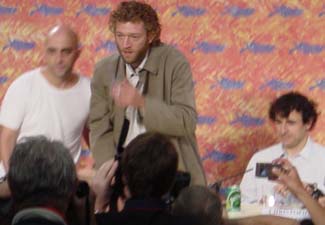
Cannes needs
scandals, said actor Vincent Cassel at the press conference
for the film Irreversible, so they manufacture
them, warranted or not. What he said at the press conference
made a lot of sense. More than a few journalists have
asked questions to filmmakers and cast by stating, "Your
film ______ is no doubt controversial…" even before
the film has been seen by an audience beyond one press
screening. It seems there is a predisposition to label
something as controversial simply because that grabs attention,
regardless of whether there has yet been an outcry or
not. After all, a thing needs to be experienced by human
beings in order to have a reaction for and or against
it. Controversy cannot exist in a vacuum. It’s more
of a misnomer, really. The anticipation of controversy
based on something provocative has replaced the definition
itself.
 |
|
Monica
Belucci
|
Having said all that, it
seems clear that Cassel may not be right. The film Irreversible
is not some innocent little movie with an unpopular notion
or two. No, it is a film about a man who seeks revenge
after his girlfriend is raped and facially disfigured.
The story is told in reverse, a dozen separate scenes.
The act of vengeance therefore comes at the beginning
of the film, deliberately robbing our sense of justice,
since we do not know at that time why the violent act
takes place, whose side we are on, if the original perpetrator
is being punished or why it is happening. We are disconnected
from the rage of vengeance that is soaking the man who
seeks it. We see this man get his faced bashed in, literally,
by another man with a fire extinguisher. Normally when
we see such a thing in films, it is shot a certain way,
the two-dimensional view that allows us to understand
the artifice of it. And the result is usually nothing
more than a bloody nose. But here, we see it happen directly,
a close-up side view. Your mind plays a trick on you,
no matter how much a veteran of violent films you may
be. Because we see it and we hear it and watch as his
nose is flattened, then his face caved in with each successive
slam of the butt of the extinguisher. From there, whether
you in the audience have recovered or not, the story moves
progressively backwards, like a pared down version of
Memento, through the evening. We see the event
that caused the need for revenge, where a woman is anally
raped in a ten minute, unbroken shot. All this with dialog
that rarely steers away from racist, sexist and homophobic
profanity. There is more after that, where the film gradually
becomes more interesting, bearable and even quite beautiful,
but too many in the audience—those that are still
there—are numb from the horrors that precede it.
Given that Cassel and Belucci
are married in real life, and are quite a famous couple
in Europe, comparisons to Eyes Wide Shut come to
mind. In fact, director Noë indicated that the desire
was to take over where Kubrick left off, where he was
too staid to go, pushing the envelope of how we respond
to peeking in at the intimacy of an actual couple. When
asked if Belucci felt their relationship was exploited
for the film, she said both exploited and celebrated.
The most extreme films I’ve seen in the past few
years have all come from France, such as Romance
and Baise Moi, both which feature actual porn actors
who have intercourse onscreen, and Noë’s own
film Seul Contre Tous, (released in the
U.S. as I Stand Alone) making Irreversible
part of a probably unintentional trend of envelope pushing.
Considering France’s consistent role in defining
and redefining cinema since the beginning, this makes
sense. And yet, I can’t decide, even days later,
if the film has any merit at all, or if it is the closest
thing yet of any major release to a snuff film. I was
impressed with it technically and with its actors and
their fearlessness, and as the shock of the two graphic
scenes fades, I try to reflect on the rest of the film.
But it is so extreme that its unrelenting desire to shock
us seems distracting, two large red blots that stain everything
else.
 |
Until Irreversible,
the most debatable film was Demonlover, an international
production that takes place in France, Japan and the U.S.
It was made by Olivier Assayas, who made the popular and
respected film Irma Vep several years ago. Demonlover
has the ambition of being a true 21st century
film with its post-modern style and subject matter. Assayas
spoke of reading the works of Don DeLillo as he wrote
the screenplay. Connie Nielsen, Charles Berling, Chloe
Sevigny and Gina Gershon are the main actors, and the
film is about espionage in the corporate, global world.
It is a drama and spy thriller, with a musical score from
Sonic Youth and has some of that Japanese anime sex that
is all the rage. People jeered and cheered after the film
as they would later for Irreversible. Like that
film, I don’t know if I think Demonlover is
successful in what it is trying to do, but I still can’t
get it out of my skin.
***
After his last film The
Ninth Gate, a pulpy, silly eschatological thriller
starring Johnny Depp, it was a surprise that Roman Polanski
was making a long, solemn film about the Holocaust. The
Pianist, which unexpectedly won the Palme d’Or,
stars American actor Adrien Brody as a Polish Jew who
survives in Warsaw for the duration of the war, despite
the years of the ghetto and its liquidation, the deportation
of all of his family and friends and the eventual destruction
of Warsaw itself at the hands of the Nazis. Though there
are more than a few excellent moments and ideas, I don’t
think the film is successful. In fact, I was a bit disappointed
compared to the press kit, with its stark, beautiful black
and white matte photographs that gave a different impression.
The film looks more like a TV movie, and does not really
explore the events in ways that haven’t been done
before in other films.
There is always a burden
on films about the Holocaust, the attempt to portray horrific
events of such magnitude in a way that does not cheapen
the history, make them either trite, oversimplified or
even sadistic. "Emotion pornography" is how David Mamet
labeled Schindler’s List. Despite the impressive
Adrien Brody, the film seems to be following a pattern
of presentation. And yet, toward the end (skip the rest
of this paragraph if you do not want to know the plot),
already a bit emaciated and nearly on his last leg, he
is discovered living in an attic of an abandoned house
by a Nazi who helps him survive by bringing him food from
the Nazi office and even the coat off his back. I found
myself incredulous at the prospect of this notion. Immediately
the film was lost on me, seemingly trading in logic for
good drama. Politically it seemed a joke; the only Nazi
whose name we learn is one of the "good ones." Elvis Mitchell
pointed out in the New York Times that the film
is a "bland, glib melodrama that softens its impact by
robbing its protagonist of the resourcefulness and physical
courage it must have taken to survive." At the end of
the film a title card comes up and we learn that Wladyslaw
Szpilman was indeed a real man, a well-known pianist in
Poland who died two years ago at the age of 88. He was
never able to locate the Nazi who helped him, a man who
died in a Soviet prison camp in 1952, but befriended the
man’s family. Suddenly I had to reevaluate it; this
is a true event, documented in Szpilman’s own autobiography,
and I am ridiculing as preposterous a relationship that
actually took place. This is the complication of trying
to make representative stories out of particular individual
cases. One can object to a film itself as unsuccessful
and simply not good, but politics of presentation has
to stay out. This was one man’s experience of many,
and like all films about history, the truth is stranger,
more horrific and also more absurd than fiction.
***
 |
Like its opening film,
Hollywood Ending, the closing film is light. And
Now, Ladies and Gentlemen… is a romance novel
on the screen. Starring Jeremy Irons and famous French
singer Patricia Kass in her first film, it is a laughable
romp, the sprightly story of a jewel thief who experiences
strange blackouts and finds companionship in a singer
with the same little problem, though it doesn’t stop
the two of them looking sexy throughout, on location in
Paris, London and Morocco. There is sailing, smoky lounges,
mystical oracles and dialogue that rivals the love story
of Attack of the Clones. It is like a perfume commercial
co-directed by Danielle Steel and John Cleese on a bad
day. In reality, it is the latest film from Claude LeLouch
the veteran filmmaker of A Man and A Woman and
many other notable French films throughout the last fifty
years. My biggest complaint is how cavalier it seemed
to be about cancer, using brain tumors as plot devices.
The press screening had laughter where it wasn’t
intended, and everyone joked at its failure as a film…
then ran to the press conference the next day to see its
two stars. There had to be a reason that Irons was in
this film, and it certainly wasn’t the words he had
to say (Groaningly bad is the same in any language, and
he had his share of off-the-cuff platitudes). "It enabled
me to do many of the things I love doing. Sailing. Dressing
up in a woman’s clothes [done for a jewelry story
robbery]. I love singing, traveling… walking though
deserted places with beautiful women."
***
Despite two or three films
a day, I still did not manage to see all the films, and
even missed a few that were in competition. But of those
I saw, there were more than few that good or bad, provoked
me in some way.
24 Hour Party People—The
story of the English music boom beginning with the Sex
Pistols and the creation of bands like Joy Division. An
entertaining story told in a self-referential almost meta-fictional
sort of way.
Divine Intervention—A
fantasy comedy/drama about life between Jerusalem and
the West Bank for a few Palestinians. It is quite a well-crafted
poem of a film and in many ways gives a different look
on life in an area that always looks violent. The last
thing I was expecting was a funny, quiet film, and it
won the jury prize.
Ararat—From
Canadian Atom Egoyan, a look at the way events forgotten
by history are presented, namely the Turkish massacre
of the Armenians in 1915. The story takes place in the
present day as a film about the events is being made.
This is far from Egoyan’s best film, and has some
very awkward and clunky moments, but it is quite engaging.
Kedma—An
Israeli film about the week before statehood was declared.
The film is a series of long scenes, each a one act play
almost, that presents those arriving and already living
in Palestine. Long takes that are director Amos Gitai’s
style, and an unsparing look behind the myth of the nation’s
founding.
Ten—Ten
moments in a car, with a camera pointed at an Iranian
woman and her passengers. We see moments of complicated
lives of Iranian women, and from anecdotes and simple
conversation a narrative arises, the complicated, difficult
life of this recently divorced woman who tugs for power
with her pre-teen son. Again, all of this from dashboard
mounted cameras.
And then there are those
that I’ve already written about: Le Fils, About
Schmidt, 17 Times Cecile Cossard, Bowling For Columbine
(which won the "al’unanimite" prize, given only
every five years ) and Punchdrunk Love (which tied
another film for the "Mis-en-Scene" prize).
***
All day Sunday, even before
the Palme D’or and other awards were announced, the
media stands were being dismantled and packed up. People
were saying goodbye. It was like overnight camp, having
spent almost two weeks with the same people, new and old
friends. But here, they announced the winner of the Palm
d’Or at a black tie ceremony with a whole bunch of
stars in attendance, and, then everyone goes outside to
the ocean and walks by the palm trees because summer is
only beginning.
You
Talkin' To Me?
Scorsese shows us the half-monty
By Grant Rosenberg
"What's
the Difference Between a Duck?" and other Questions
By Grant Rosenberg
Here
We Are Now, Entertain Us...
Because We Have Stories To File
By Grant Rosenberg
Pre-Cannes
Conference:
The festival's lineup is announced
By Grant Rosenberg
04-22-02
|