|
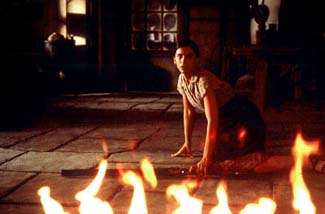
Images floated on the
screen as if caught in liquid amber during the opening
moments of Spain's The Devil's Backbone (directed
by Guillermo del Toro). Rainwater swirled and mixed with
a dead boy's body until, finally, the body morphed into
a gilled fetus. Only a few people sat near me in the old
unheated movie palace as I felt my heart thump a little
harder. It was snowing outside and I'd have to walk home
alone when the movie let out, well after midnight. The
Devil's Backbone, I thought, was going to be great.
I was going to be too scared to breathe.
After two hours of watching
gorgeous cinematography, sincere acting and stellar special
effects I was far from frightened; more like the victim-viewer
of a group therapy session disguised as a horror movie.
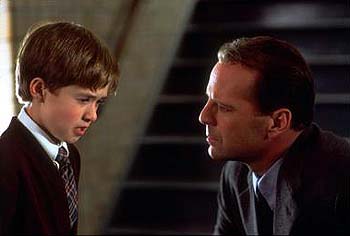
First, there was The
Sixth Sense. Then, The Others. And now, The
Devil's Backbone. Over the last few years, a certain
trend has developed in mainstream horror filmmaking, best
represented by these three movies. They're all blockbuster
visual orgies that rip the "scary" out of "scary movie."
The late nineties brought a slew of teen gore flicks but,
outside of Scream, none of them stuck. The Blair
Witch Project was a singular blip on the radar and
Troma is, as always, Troma. That said, a certain formula
has emerged we'll call Sixth Sense Syndrome (SSS).
The first principle in
these three recent films is that everyone is, deep down,
good. We're talking ghouls with hearts of gold. The bumps
in the night? Morse code from beyond telling us to love
each other.
Until now, monsters and
ghosts were motivated by evil, Satan's command, base desires
or insanity. Dracula's sick, sexual blood suck unto eternity
was just that. In the three movies mentioned above ghosts
have feelings, not evil urges. They are sentenced to a
limbo existence where they try to communicate a sort of
pop-psychology morality to the living, and are frustrated
in their attempts by the living's reactions to their bloody,
nasty visages.
 |
More importantly, the victims
are good, too. Most horror movie victims used to be as
trapped by their tragic flaws (greed, sex, pride, affection
for controlled substances) or needs (sleep, shelter) as
they were by the hounds of hell. Now, they are noble soldiers
overcoming prejudice about the dead to learn an important
lesson on love and the beauty of interpersonal communication.
In each of these films, the living struggle to accept
the ghost before them whether it is only a shadow, a puking
girl or a blood-leaking aqua-boy.
The hero-victims must be played by those who lack the
possibility of tragic flaws, people both noble and naive.
In other words, kids. Viewers can relate to the childhood
fears that play out on the screen, such as one of the
boys in The Devil's Backbone wondering if something's
under his bed, and, at the same time, believe the characters
are guiltless and uncomplicated victims. The kids in Village
of the Damned wanted to wipe out the entire human
race; the brother and sister in The Others just
want to keep their little lights a'shine.
The twist is the most important
element for films with Sixth Sense Syndrome and
it only works if we believe everyone starts out with the
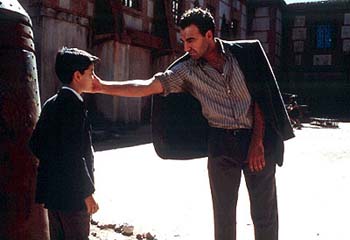
best intentions. Jacinto blows up and stabs people in
The Devil's Backbone because he's an orphan. Nicole
Kidman's Grace suffers from a really bad case of Seasonal
Affective Disorder.
 |
|
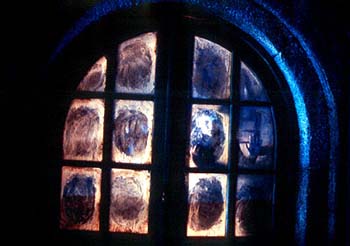
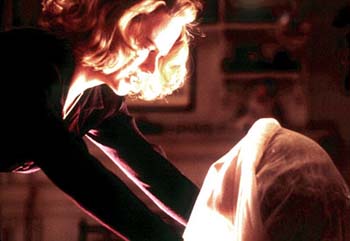
The
ghost in The Devil's Backbone
|
When the twist is finally
revealed, all of our assumptions are turned upside down
and we learn that the story we thought we were seeing
was not the story we actually saw. The perspective we
followed was somehow skewed or, again, the characters
who looked like bad guys were actually bad-looking good
guys. The twist then flowers into a short-lived reconciliation
between the living, dead, un-dead, un-living, born and
un-born. The characters have a few minutes to find their
balance, tell what's on their mind, deliver a thesis on
being good and reaffirm their love for one another. In
The Devil's Backbone, this plays out with a slight
variation. The murdered boy vengefully drowns his murderer.
Even then, the dead and living are able to confront each
other and resolve their differences.
The mild reconciliation
leads to a melancholy ending where the main characters
leave one another to face their respective sides of mortality's
coin alone.
If Psycho had been
made as one of these magic realist head shrinkings, nine-year-old
Norman Bates' dead mother would have appeared to him with
an axe in her skull and explained the birds and bees better
than she obviously did when she was alive. The mother's
soul would have returned to limbo and Norman would have
grown up to be a slightly depressed man, not a cross-dressing
taxidermist/serial killer. But, would that have been scary?
No.
 |
Affection between the dead
and living has existed in films before, but as an ill-fated
love story (The Ghost and Mrs. Muir, Always, Ghost
and Truly, Madly, Deeply) or some sort of comedy
where the ghost orchestrates tricks for the living. To
adapt this concept for horror movies, directors and writers
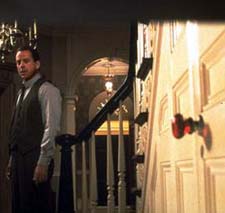
have to insert lots of superficial thrills. The Others
has some jump-out-of-your-seat scenes. The scene that
was cannibalized for the previews and commercials, for
example, where Grace asks a veiled figure about her daughter,
includes a creeping camera, empathy-inspiring acting and
an unwelcome surprise. This jack-in-the-box moment, though,
is only good for an instantaneous spine tingle and following
scenes play as romance or comedy (until another thrilling
moment pops up) as if we had never seen the wrinkled face
under the veil. The scares in SSS-afflicted movies
don't go for the gut or the heart. They shoot across the
skin like an electric shock and then dissipate. They don't
sustain anything as unsettling as Norman Bates' interior
monologue at the end of Psycho, which holds viewers'
imaginations long after the credits roll.
The other reason a head-shrunk
Psycho wouldn't have been scary is that it would
have made sense. Death is unexplainable and existence
after death is unknowable. Good horror movies keep this
as their model, bad ones reveal all of the whys and hows.
The rational is conquerable and, therefore, not scary.
By providing a twist and rigorous logic leading to that
twist, films with SSS bind us to faith in reason
and disallow horror movies' supernatural nonsense.
Night of the Living
Dead's first scene is tongue-swallowing frightening.
It takes place at dusk in a cemetery with a brother and
sister visiting their parents' graves, playing on a whole
host of innate human fears. The audience gasps as one
nasty zombie unexpectedly grabs the sister as she passes,
but the spine tingle doesn't end with just this trick.
The sister's ensuing nonsensical hysteria disrupts the
story, disorients the viewer and haunts the first third
of the film. Her chaotic, unreasonable activity becomes
more frightening than the zombie who initially rubbed
his decomposing mitts over her. Consider that a rational
explanation is never offered for how a flock of birds
decides to use Tippi Hedren and pals as supersized sesame
sticks, which is why The Birds frightens viewers
over and over again. We never know how Norman's psychosis
developed.
Occasionally, even the
best horror movies provide reasons for the suffering on
screen, but these rationalizations are weak and unimportant,
and often as fantastical as everything else that's happened.
Think about the logic behind the original Invasion
of the Body Snatchers. Aliens plant a pod in your
garage that grows your clone that takes over your life
when you fall asleep, even if you only nod off for a millisecond
miles away from pod and clone. Once the clone assumes
your identity, your body just disappears into thin air.
No matter how well-scored
or well-made SSS-suffering films are, we
cannot deny that, at their roots, they are over-resolved
cases of misunderstanding with a few jolts tacked on.
And no matter what type of poetic sadness their endings
impart, they are not horror movies.
For most audiences, the
films' failures to live up to the horror genre will be
easy to ignore. Their final twists will continue to surprise
and the grounded reasoning as easy to swallow as the concession
stand's $3 popcorn. I'm sure, as I write, the preview
for Dragonfly, which promises to suffer from acute
SSS, is making someone jump. But a few of us will
stumble accidentally into an SSS-inflicted film
and grumble to ourselves like the town witches that we've
been robbed, cheated and jilted.
 |
People don't go to horror
movies to feel all right about life. That's what Julia
Roberts' cinematic corpus is for. Horror movies
are the mental playgrounds where we scamper with our instinctual
fears. We're allowed to indulge the grotesque images and
sensations that we summon and dismiss when confronted
with spooky situations in real life. If humans constantly
responded to our fears we would never take risks, leave
the house or, even, move. So, we repress our fears or
talk ourselves out of them. But, for a few hours in a
horror movie, we have the healthy release of doing the
opposite.
Characters rarely
win in horror movies. That's because the genre acknowledges
one important truth: we all lose in the battle against
death. The will to survive is too strong for us to affirm
that dying right now is as good as dying when we're in
the nursing home. So, we repress this truth as much as
our fears. Celluloid fantasies crammed with nearly unrelated
images and accompanied by a creepy soundtrack allow us
to give a nod to death without participating in it. A
film suffering from SSS promises to present fear's
playground, but then explains fear away. It shows us death,
but then creates a sense of triumph.
Perhaps the scariest film
I've watched was a restored late-night gross-out fest
(bad sound, bad film stock, bad hair) about Hell's gates
opening in a bed and breakfast basement—the opposite
of an SSS-cursed work. During the conclusion, the
leads flee a hospital floor full of zombies by running
down a set of stairs, and find themselves in the B&B
basement. There's no explanation offered for the geographical
confusion. Unable to escape the basement, the two venture
through Hell's yawning entrance to be locked in eternal
suffering amidst writhing bodies. The film proposed something
more frightening, and somehow deeper, than anything The
Sixth Sense could muster that made me sleep that night
with the light on: In the end, we are all death's bitch.
|